Building Germany's Sovereign
AI Infrastructure Backbone
DSAINT is a distributed sovereign AI infrastructure movement that combines professional infrastructure ownership with citizen participation through Reverse Co-Hosting. By connecting core infrastructure nodes, research institutions, industry, municipalities and community-operated AI nodes, DSAINT enables everyone to contribute to Germany's independent AI future.
Reverse co-hosting is the future of Germany's independent AI – a future in which everyone can participate.
The DSAINT Ecosystem
A sovereign AI infrastructure model connecting Core Infrastructure Nodes, the Community Compute Federation, municipalities, enterprises and research institutions into a resilient national AI ecosystem.
Core Infrastructure Network
Twelve environmentally friendly Tier III AI-optimized infrastructure nodes located in medium-sized German municipalities.
With capacities ranging from 2 MW to 6 MW and a target PUE ≤ 1.20, they provide the secure and sovereign backbone of Germany's sovereign AI future.
Core Nodes deliver low-latency AI services, coordinate the Community Compute Federation, redirect compute-intensive workloads to Citizen AI Nodes, and accurately measure network contributions to ensure fair and transparent compensation for all participants.
Community Compute Federation
Citizen AI Nodes connected through Reverse Co-Hosting.
Inspired by the anthill principle, thousands of small contributions form a powerful collective computing resource.
Optimized for high-workload tasks such as AI video generation, biochemical simulations, scientific computing and digital twin modeling.
By distributing workloads across the network, DSAINT enables slower but significantly more affordable processing while making advanced AI capabilities accessible to businesses, researchers and citizens alike.
Municipal • Enterprise • Research Network
Connecting municipalities, enterprises, universities and research institutions into a collaborative sovereign AI ecosystem.
DSAINT enables trusted cooperation through dedicated secure networks, encrypted standard formats and protocols, strict access control and identity management, and compliance with GDPR and applicable state regulations.
Security architecture is guided by the BSI IT-Grundschutz framework, ensuring that innovation, research and industrial AI deployment can operate within a secure, resilient and sovereign infrastructure environment.
Why Germany Needs Sovereign AI Infrastructure
Artificial intelligence is becoming a critical component of economic competitiveness, scientific innovation and national resilience. Germany requires secure, scalable and sovereign infrastructure capable of supporting the next generation of AI.
AI Demand Explosion
AI workloads continue to grow rapidly across industry, research, healthcare and public services, creating unprecedented demand for compute infrastructure.
Digital Sovereignty
Critical AI infrastructure should remain under German and European governance to ensure security, compliance, resilience and strategic independence.
Cost of Advanced AI
High-compute workloads such as AI video generation, scientific simulations and digital twin modeling remain expensive and inaccessible for many organizations.
Untapped Community Potential
Millions of citizens, small businesses and organizations could contribute computing resources through Reverse Co-Hosting and participate directly in Germany's sovereign AI future.
The DSAINT Response
DSAINT combines environmentally friendly Core Infrastructure Nodes with a Community Compute Federation of Citizen AI Nodes.
Fast-response AI services are delivered through the Core Infrastructure Network, while compute-intensive workloads can be distributed across thousands of Citizen AI Nodes, creating a scalable, resilient and economically inclusive sovereign AI ecosystem.
Why DSAINT
DSAINT is not merely an AI infrastructure project. It is a sovereign AI ecosystem that combines Core Infrastructure Nodes, Community Compute Federation participants and trusted institutional partners into a resilient national platform.
Sovereign AI Infrastructure
DSAINT strengthens Germany's digital sovereignty through a distributed network of secure AI infrastructure nodes operated under European governance, security and compliance standards.
Reverse Co-Hosting
Citizen AI Nodes enable ordinary people to participate directly in the development of Germany's independent AI future while receiving compensation for their contributions.
Community Compute Federation
Inspired by the anthill principle, thousands of Citizen AI Nodes combine to process compute-intensive workloads such as AI video generation, scientific simulations and digital twin modeling.
Long-Life Infrastructure Assets
DSAINT focuses on ownership and operation of land, facilities, power systems, cooling infrastructure, connectivity and security systems rather than rapidly depreciating AI hardware.
A New Model for Sovereign AI
DSAINT combines environmentally friendly Tier III Core Infrastructure Nodes with a nationwide Community Compute Federation.
Fast-response AI services remain within the Core Infrastructure Network, while compute-intensive workloads are distributed across Citizen AI Nodes through Reverse Co-Hosting.
This approach creates a scalable, resilient and economically inclusive AI ecosystem in which municipalities, enterprises, universities, research institutions and citizens all participate in Germany's sovereign AI future.
The DSAINT Vision
DSAINT is building Germany's sovereign AI infrastructure backbone through a distributed network of environmentally friendly AI-optimized infrastructure nodes, research partnerships, enterprise collaboration and citizen participation.
Inspired by the anthill principle, DSAINT combines secure Core Infrastructure Nodes with a Community Compute Federation of Citizen AI Nodes. Together they form a resilient, scalable and sovereign ecosystem capable of supporting Germany's next generation of artificial intelligence.
Reverse Co-Hosting
Reverse co-hosting is the future of Germany's independent AI – a future in which everyone can participate.
Through the DSAINT Citizen Node Program, households, businesses and community organizations can host secure AI infrastructure units, contribute computing capacity to the national network and receive compensation based on the value they help create.
DSAINT Ecosystem
DSAINT is designed as a multi-layer sovereign AI ecosystem connecting infrastructure, research, industry and citizens into a resilient national AI platform.
Core Infrastructure Network
Twelve environmentally friendly Tier III AI-optimized Core Nodes form the sovereign backbone of the DSAINT ecosystem. These facilities provide low-latency AI services, infrastructure orchestration and secure network operations.
Research & Innovation Nodes
Universities, research institutes and HPC facilities connected to the DSAINT ecosystem accelerate scientific research, AI development, digital twin modeling and technological innovation.
Industrial & Enterprise Nodes
Manufacturing companies, utilities, healthcare providers and enterprise operators deploy AI infrastructure for commercial, industrial and mission-critical applications.
Community Compute Federation
The Community Compute Federation connects Citizen AI Nodes through the Reverse Co-Hosting model. Inspired by the anthill principle, thousands of participants contribute computing resources while receiving compensation based on their measured contribution to the network.
Reverse Co-Hosting
Reverse co-hosting is the future of Germany's independent AI – a future in which everyone can participate.
Instead of renting infrastructure space to customers, DSAINT enables citizens, startups and organizations to host secure Citizen AI Nodes and contribute computing resources to Germany's sovereign AI ecosystem.
Inspired by the anthill principle, thousands of small contributions combine into a powerful collective resource capable of supporting AI video generation, biochemical simulations, scientific computing and other compute-intensive workloads.
Citizen Nodes
Host secure AI units and participate in Germany's sovereign AI future.
AI Video Generation
Affordable processing of high-compute creative workloads.
Scientific Simulation
Distributed compute for biochemical and research workloads.
Fair Compensation
Rewards based on measured contribution to the federation.
Germany's Sovereign AI Federation
DSAINT aims to connect Core Infrastructure Nodes, Community Compute Federation participants, municipalities, enterprises, universities and research institutions into a resilient sovereign AI ecosystem that strengthens Germany's digital independence and technological leadership.
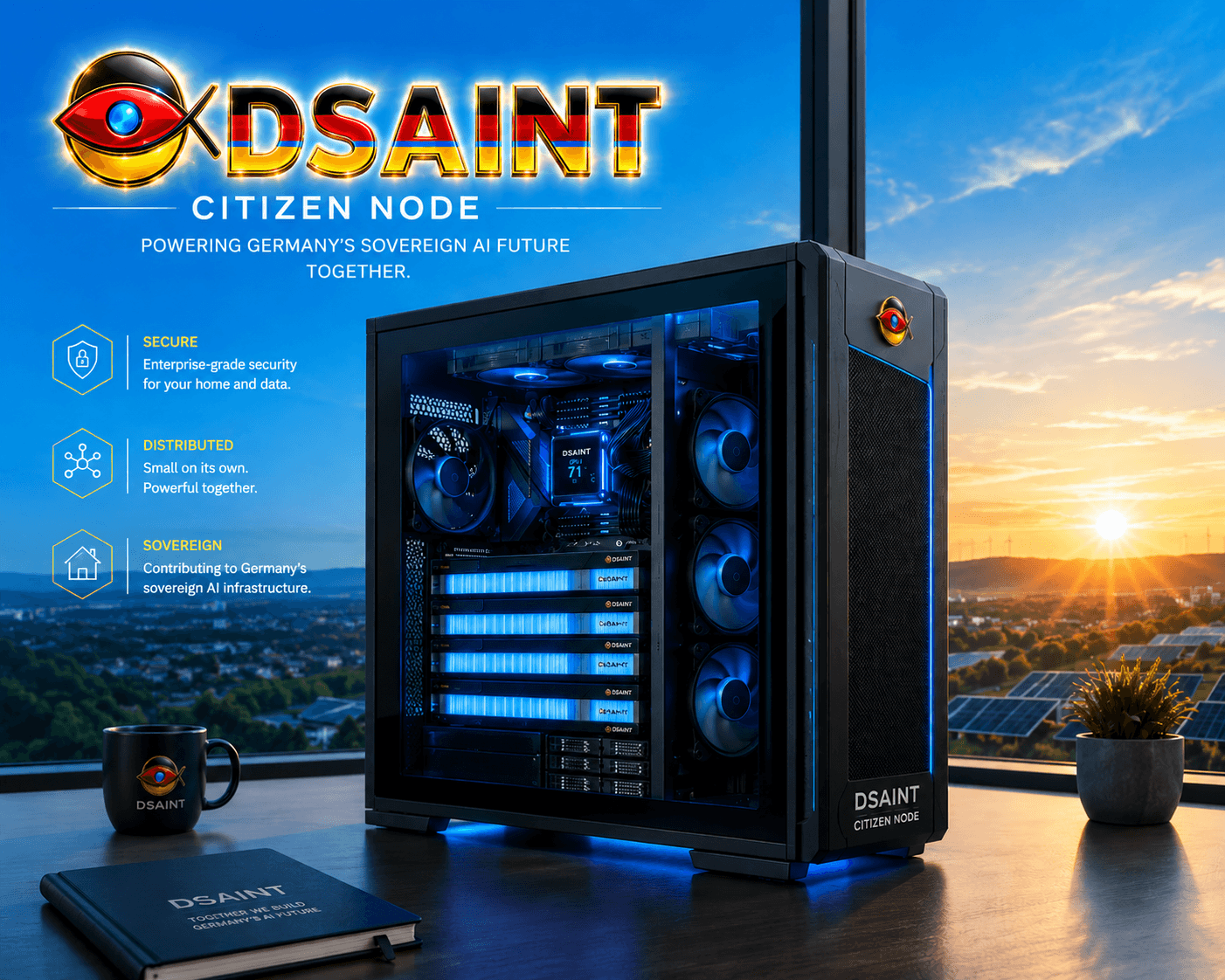
DSAINT Citizen AI Node
A secure AI appliance designed for the Community Compute Federation. Through Reverse Co-Hosting, citizens, startups and organizations can participate directly in Germany's sovereign AI future.
Reverse Co-Hosting
The DSAINT Citizen Node is a compact AI system that can be hosted in homes, offices and community organizations.
Inspired by the anthill principle, thousands of Citizen Nodes combine into a powerful Community Compute Federation capable of supporting AI video generation, scientific simulations, biochemical modeling and other compute-intensive workloads.
Participants receive compensation based on their measured contribution, helping create a more inclusive and resilient sovereign AI ecosystem.
Citizen Node Configurations
The DSAINT Community Compute Federation supports multiple node classes ranging from individual citizen participation to advanced research and innovation deployments.
Citizen AI Node S
Entry-Level Community Node
- • 8–12 Core CPU
- • 64–128 GB RAM
- • 2–4 TB SSD
- • 1× 16 GB GPU
- • 500 W Power Supply
Target Users
Citizens, students, AI enthusiasts
Citizen AI Node M
Advanced Community Node
- • 16–24 Core CPU
- • 128–256 GB RAM
- • 4–8 TB SSD
- • 2× 24 GB GPU
- • 1.5 kW Power Supply
Target Users
SMEs, startups, researchers
Citizen AI Node L
Professional Federation Node
- • 32–48 Core CPU
- • 256–512 GB RAM
- • 8–16 TB SSD
- • 4× 32 GB GPU
- • 3 kW Power Supply
Target Users
Universities, laboratories, professional contributors
Citizen AI Node XL
Research & Innovation Node
- • 64–96 Core CPU
- • 512 GB–1 TB RAM
- • 16–32 TB SSD
- • 8× 48 GB GPU
- • 5 kW Power Supply
Target Users
Research institutions, AI startups, scientific computing centers
Four-Layer DSAINT Architecture
DSAINT combines sovereign infrastructure, research, industry and community participation into a resilient national AI ecosystem capable of supporting Germany's long-term digital sovereignty.
Layer 4 — Community Compute Federation
Citizen AI Nodes connected through Reverse Co-Hosting. Inspired by the anthill principle, thousands of participants contribute computing resources while receiving compensation based on their measured contribution to the network.
Layer 3 — Industrial & Enterprise Nodes
Manufacturing companies, healthcare providers, utilities and enterprise operators utilizing sovereign AI infrastructure for commercial, industrial and mission-critical workloads.
Layer 2 — Research & Innovation Nodes
Universities, research institutions and HPC facilities connected through secure networks to accelerate scientific research, AI development, digital twins and biochemical simulations.
Layer 1 — Core Infrastructure Network
Twelve environmentally friendly Tier III AI-optimized Core Nodes providing low-latency AI services, sovereign infrastructure, orchestration of Citizen Nodes and contribution accounting for the Community Compute Federation.
Reverse Co-Hosting Architecture
Fast-response AI services are delivered through the Core Infrastructure Network, while compute-intensive workloads such as AI video generation, scientific simulations and digital twin modeling can be distributed across thousands of Citizen AI Nodes.
This creates a scalable, resilient and economically inclusive sovereign AI ecosystem in which municipalities, enterprises, universities, research institutions and citizens all participate in Germany's AI future.
Technology & Infrastructure
DSAINT combines environmentally friendly AI infrastructure, sovereign security architecture and distributed compute orchestration to create Germany's next-generation AI ecosystem.
Advanced Cooling
Direct-to-chip liquid cooling and energy-efficient infrastructure design support high-density AI workloads while targeting a PUE of ≤ 1.20.
Multi-Carrier Connectivity
High-availability fiber connectivity with redundant carrier paths ensures resilient communication between Core Nodes, Citizen Nodes and ecosystem partners.
Sovereign Security
Security architecture based on BSI IT-Grundschutz, dedicated secure networks, encrypted protocols, strict identity management and GDPR compliance.
Core Node Orchestration
Core Infrastructure Nodes provide low-latency AI services, coordinate workloads across the federation and manage secure network operations.
Community Compute Federation
Reverse Co-Hosting enables Citizen AI Nodes to process compute-intensive workloads including video generation, scientific simulations and digital twin modeling.
Contribution & Rewards
Core Nodes continuously measure uptime, reliability and compute contribution, enabling transparent and fair compensation for Citizen Node operators.
Sustainable by Design
DSAINT combines energy-efficient infrastructure, municipal integration and distributed computing to create a more sustainable approach to sovereign AI.
BTES Thermal Storage
Borehole Thermal Energy Storage enables long-term thermal management and supports efficient use of excess heat generated by AI infrastructure.
Heat Recovery
Waste heat from AI infrastructure can be redirected to support municipal facilities, public buildings and future district heating applications.
Energy Efficiency
Direct-to-chip liquid cooling, modern power systems and optimized infrastructure design target a PUE of ≤ 1.20 across the DSAINT Core Infrastructure Network.
Municipal Integration
DSAINT infrastructure is designed to become part of local communities, creating economic, educational and technological value for municipalities across Germany.
Sustainable AI Through Distribution
DSAINT combines environmentally friendly Core Infrastructure Nodes with a Community Compute Federation of Citizen AI Nodes.
By distributing compute-intensive workloads across a trusted network of participants, DSAINT improves infrastructure utilization, reduces waste and enables a more sustainable model for the future development of artificial intelligence.
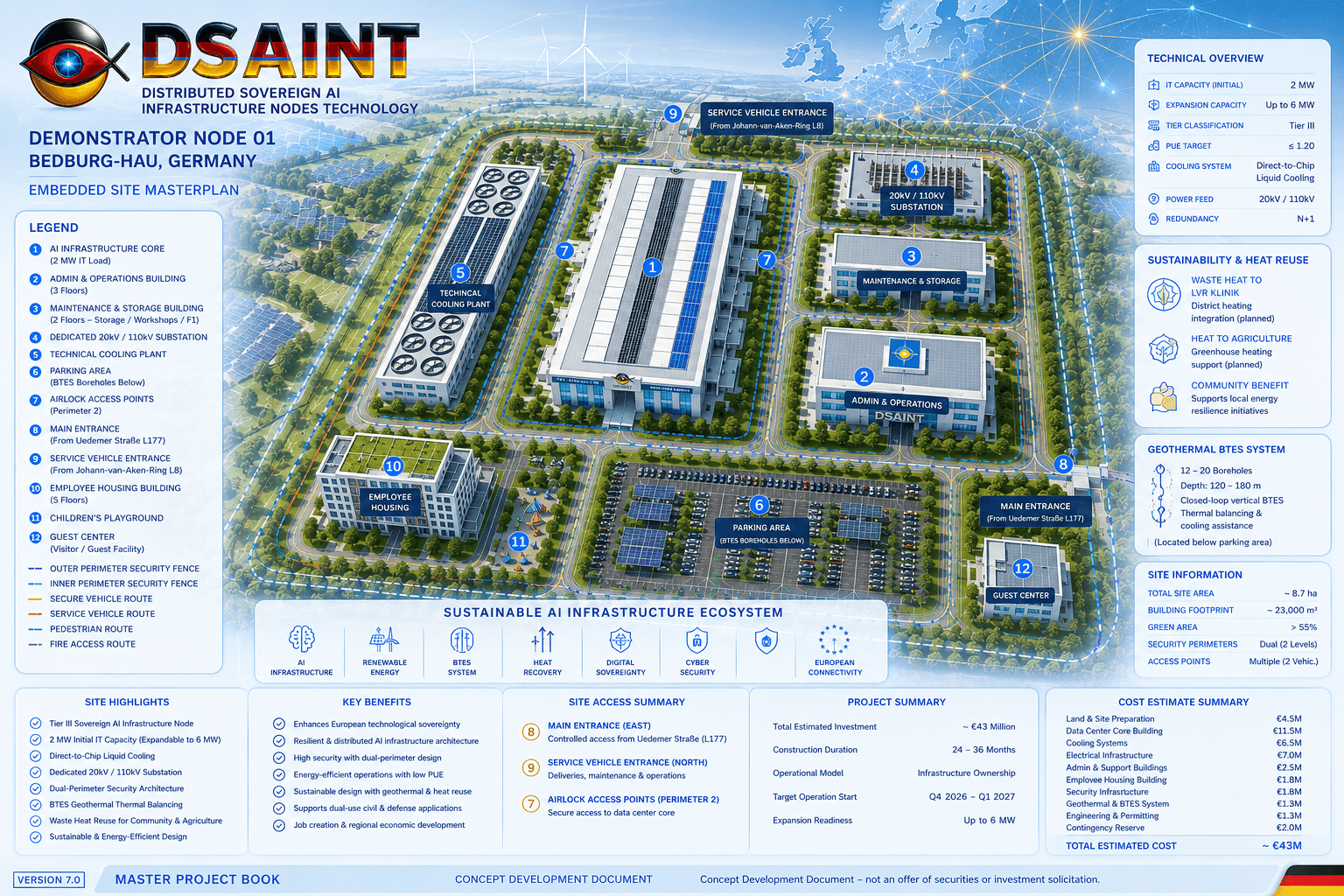
Demonstrator Node 01
Bedburg-Hau, Germany
Demonstrator Node 01 serves as the foundation of the DSAINT ecosystem and the blueprint for future deployment across Germany. Designed as an environmentally friendly Tier III AI-optimized infrastructure facility, it combines high-performance AI operations, sovereign security architecture and orchestration capabilities for the Community Compute Federation.
2 MW
Initial Capacity
6 MW
Expansion Capacity
Tier III
Infrastructure Standard
≤ 1.20
Target PUE
Fast AI Processing
Node 01 delivers low-latency AI services, hosts critical platform components and supports workloads that require immediate results and high availability.
Federation Orchestration
The node coordinates Citizen AI Nodes, distributes compute-intensive workloads, monitors performance and manages secure communication across the Community Compute Federation.
Contribution & Rewards
Node 01 measures uptime, reliability and compute contribution across the federation, enabling transparent accounting and fair compensation for Citizen Node operators.
Blueprint for Germany's Sovereign AI Future
Demonstrator Node 01 is more than a data center. It is the first building block of a distributed sovereign AI ecosystem connecting Core Infrastructure Nodes, Citizen AI Nodes, municipalities, enterprises and research institutions across Germany.
Governance & Leadership
DSAINT is designed around transparent governance, sovereign security, technical excellence and long-term stewardship of Germany's AI infrastructure ecosystem.
Supervisory Board
Provides strategic oversight, long-term direction and governance of the DSAINT ecosystem.
Executive Team
Responsible for infrastructure development, ecosystem operations and Community Compute Federation growth.
Technical Governance Board
Defines architecture standards, Core Node requirements, Citizen Node specifications and infrastructure roadmap decisions.
Security & Compliance Committee
Oversees cybersecurity, physical security, BSI IT-Grundschutz alignment, GDPR compliance and sovereign infrastructure protection.
Sustainability Committee
Guides environmental performance, energy efficiency, heat recovery and long-term sustainability objectives.
Community Federation Council
Represents Citizen Node operators and helps shape policies for participation, contribution measurement and reward allocation.
Core Governance Principles
German Sovereignty
Security by Design
Transparency & Fairness
Infrastructure Resilience
Sustainable Growth
DSAINT Development Roadmap
A phased strategy for building Germany's sovereign AI ecosystem through environmentally friendly Core Infrastructure Nodes, Community Compute Federation participants and Reverse Co-Hosting.
Demonstrator Node 01
Commissioning of the first DSAINT Core Infrastructure Node with 2 MW initial IT capacity, expandable to 6 MW. The facility serves as the operational blueprint for future sovereign AI infrastructure deployments across Germany.
Citizen Node Program
Introduction of the DSAINT Community Compute Federation, enabling citizens, startups and organizations to host Citizen AI Nodes and participate directly in Germany's sovereign AI ecosystem while earning rewards based on their contribution.
Core Network Expansion
Deployment of additional Core Infrastructure Nodes in strategically selected German municipalities, creating the first interconnected sovereign AI infrastructure network and expanding regional compute capacity.
National AI Ecosystem
Integration of municipalities, enterprises, universities and research institutions into a distributed sovereign AI ecosystem supported by Core Infrastructure Nodes and Community Compute Federation participants.
12 Core Nodes
Completion of the 12-node German Core Infrastructure Network, providing nationwide sovereign AI capacity and coordinating a large-scale Community Compute Federation of Citizen AI Nodes.
European Expansion
Expansion of the DSAINT model into a distributed European sovereign AI platform connecting nations, municipalities, enterprises, universities and communities through secure infrastructure and shared innovation.
Long-Term Vision
DSAINT aims to establish Germany's first sovereign AI federation, combining environmentally friendly Core Infrastructure Nodes, Community Compute Federation participants, municipalities, enterprises, universities and research institutions into a resilient national AI ecosystem.
By 2036, DSAINT seeks to expand this model across Europe, enabling a new generation of sovereign, secure and community-driven AI infrastructure.
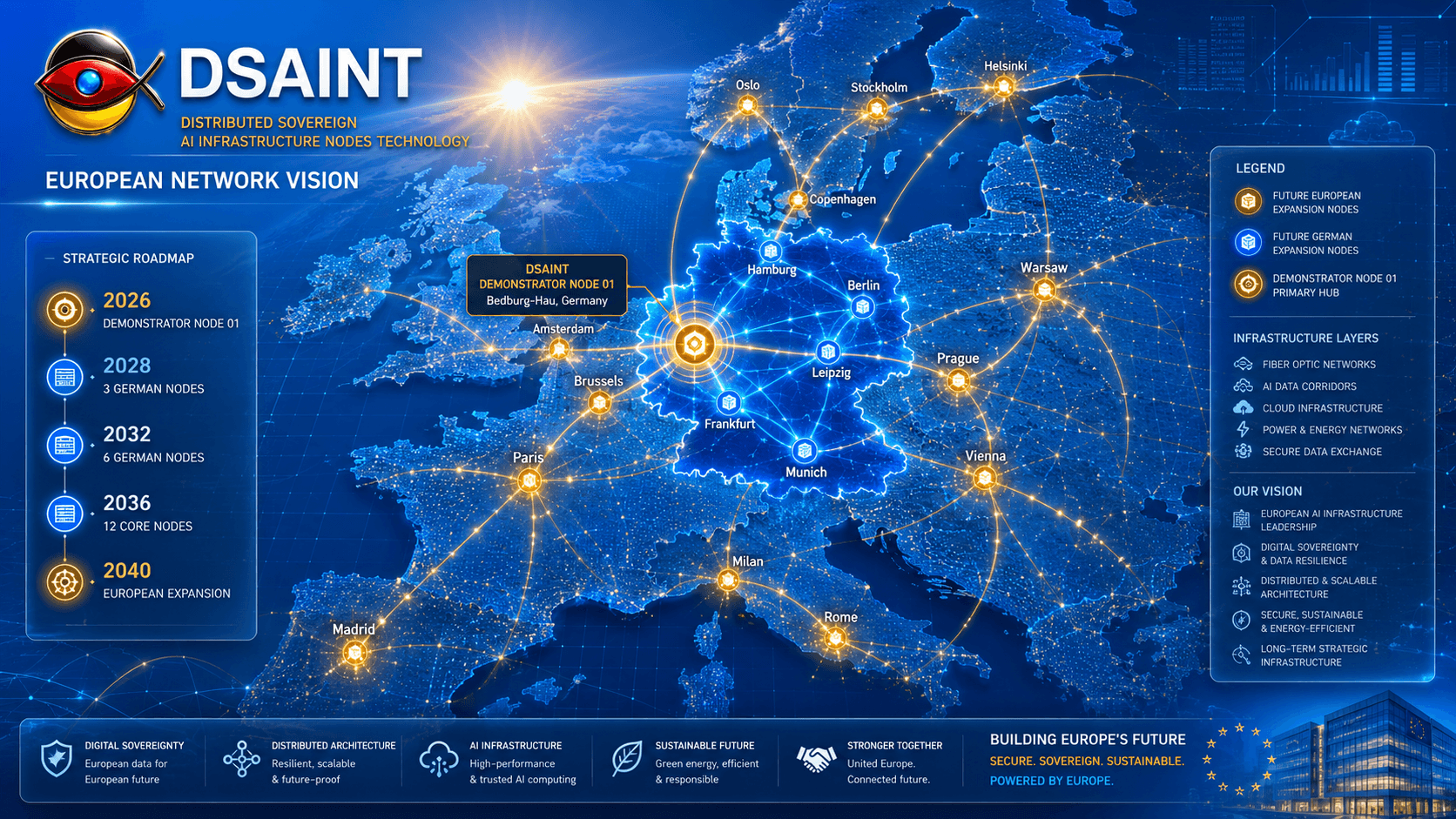
Sovereign AI Network Vision
DSAINT combines environmentally friendly Core Infrastructure Nodes, Community Compute Federation participants and trusted institutional partners into a distributed sovereign AI ecosystem designed for Germany and future European expansion.
Core Infrastructure Nodes
Twelve environmentally friendly Tier III AI-optimized infrastructure nodes form the sovereign backbone of the DSAINT ecosystem.
Citizen AI Nodes
Thousands of Community Compute Federation participants contribute computing resources through the Reverse Co-Hosting model.
Institutional Partners
Municipalities, enterprises, universities and research institutions collaborate through secure sovereign infrastructure.
European Federation
Long-term expansion connects national sovereign AI ecosystems into a resilient European infrastructure federation.
From Bedburg-Hau to Europe
Demonstrator Node 01 in Bedburg-Hau is the first building block of a distributed sovereign AI ecosystem.
DSAINT's long-term vision combines Core Infrastructure Nodes, Community Compute Federation participants and trusted institutional partners into a secure, resilient and scalable AI network that strengthens digital sovereignty across Germany and Europe.
Join the DSAINT Ecosystem
DSAINT brings together municipalities, enterprises, universities, research institutions and citizens to build Germany's sovereign AI future.
Municipalities
Host environmentally friendly Core Infrastructure Nodes, strengthen local digital sovereignty and create long-term economic value for their communities.
Universities
Access sovereign AI infrastructure for research, education, scientific simulations and collaborative innovation projects.
Research Institutions
Utilize distributed compute resources for advanced research, modeling, digital twins and large-scale scientific workloads.
Enterprises
Leverage secure sovereign AI infrastructure while maintaining compliance, security and operational resilience.
AI Startups
Access affordable AI compute resources and infrastructure without dependence on hyperscale cloud providers.
Citizen Node Operators
Participate in the Community Compute Federation through Reverse Co-Hosting and receive compensation based on their contribution to the network.
Utilities & Energy Partners
Support sustainable infrastructure development through innovative energy integration, heat recovery and grid collaboration.
Infrastructure Investors
Participate in the long-term development of sovereign AI infrastructure as a durable strategic asset class.
Public Sector Organizations
Benefit from secure AI infrastructure aligned with BSI IT-Grundschutz, GDPR and national digital sovereignty objectives.
A Shared Infrastructure Future
DSAINT is more than a data center network. It is a collaborative ecosystem connecting Core Infrastructure Nodes, Community Compute Federation participants and trusted institutional partners.
Reverse co-hosting is the future of Germany's independent AI – a future in which everyone can participate.
DSAINT Resources
Explore the key documents behind the DSAINT concept, business model, financial framework and Demonstrator Node 01.
DSAINT Concept Development Document
Complete overview of the DSAINT vision, infrastructure model and long-term strategy.
View PDFContact DSAINT
Discuss infrastructure partnerships, municipal cooperation, investment opportunities, technology integration, research collaboration, or future node development within the DSAINT ecosystem.